


An important learning moment in a power-electronics laboratory often occurs when the waveform does not match the simulation. Ripple may be larger than expected, a transient may be slower, a controller may behave differently in hardware, or a protection limit may interrupt the test. The experiment then becomes an engineering problem to diagnose, with the measured waveform as the starting point for reasoning.
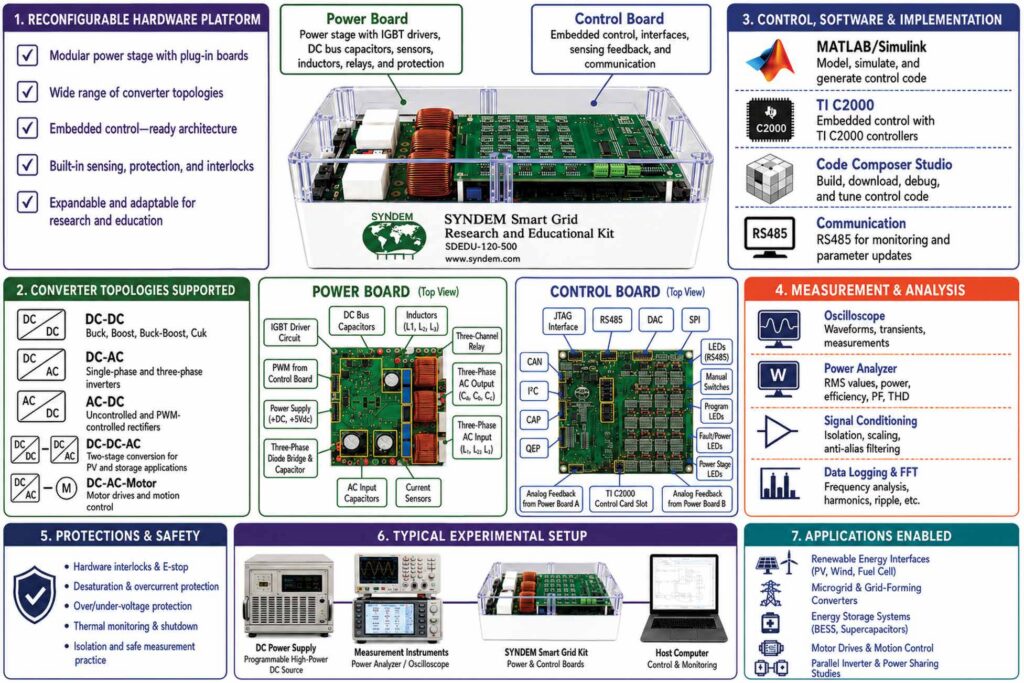
Modern converter practice requires engineers to work across power stages, embedded control, sensing, signal processing, communication, and hardware protection [1]. They must interpret steady-state operation, transient response, modulation, harmonic content, feedback behavior, sensor scaling, and implementation constraints as interconnected parts of one engineering problem [2]. A laboratory course can provide this integration before graduation. This article asks how much of this content senior undergraduates can learn, demonstrate, and verify in hardware. The experience shows that an intentionally structured sequence can support high experimental competence. Students can move beyond abstract circuit theory and simulation [3] to engage real converter hardware, interpret measured behavior, and connect theory, control, code, and instrumentation in engineering decisions [4]. At K-State, students first developed confidence with safety practices, measurement tools, software setup, and initial waveform acquisition. They then advanced through converter fundamentals, closed-loop regulation, inverter modulation, harmonic analysis, cascaded conversion, rectification, motor-drive operation, and application-level final projects. Each step added technical complexity while reinforcing the same discipline: predict the behavior, test the hardware, interpret the evidence, and explain the result. Running such a course also creates a design challenge. Hardware setup, board development, embedded-code preparation, software configuration, protection limits, and measurement safety can consume time intended for learning. The course therefore needed a platform that preserved real converter behavior while reducing repeated setup and low-level coding.
For more on this article click here.