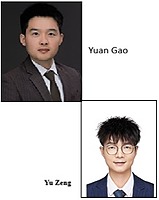
Yuan Gao (Member, IEEE) received his PhD degree in Electrical and Electronic Engineering (EEE) from the University of Nottingham, Nottingham, UK, in 2021. He studied his masters in Aeronautical Engineering at the Beihang University, Beijing, China, 2014-2017. He finished his Bachelor of Engineering degree in 2013 at the Dalian Maritime University, Dalian, China. In Feb 2023, He joined the School of Engineering at the University of Leicester, Leicester, UK, as a lecturer in EEE. Prior to that, he was a postdoc research associate in hybrid autonomous system engineering, Department of Aerospace Engineering, at the University of Bristol, Bristol, UK. His research interests include motor drive, model predictive control, multi-agent autonomous system, AI-aided design, control, and maintenance for power electronics.
Dr. Gao is a Guest Editor for IEEE TRANSACTIONS ON POWER ELECTRONICS, a Special Issue Lead Guest Editor for Aerospace/Sensors/Electronics Journal, an Associate Editor for IET Power Electronics, e-Prime, Electronics and Signal Processing, and a Reviewer for multiple IEEE Transactions journals. He also serves as the financial chair of ISEEIE 2024, a Session Chair of IECON 2025, ESARS-ITEC 2024, AIAA/IEEE EATS 2020. He is a recipient of a highly prestigious Chinese National Award for Outstanding Students Abroad in 2021.
Yu Zeng (Senior Member, IEEE) received the B.S. and M.E. degrees in electrical engineering from Shandong University, China, in 2017 and 2019 respectively, and the Ph.D. degree in electrical engineering from Nanyang Technological University (NTU), Singapore, in 2023.
From 2023 to 2026, he worked as Research Fellow in NTU, and City University of Hong Kong, respectively. He is currently a UESTC100 Young Professor at Shenzhen Institute for Advanced Studies (SIAS), University of Electronic Science and Technology of China (UESTC). His research interests include power electronics systems, artificial intelligence, renewable energy sources, and electric aircraft. He received the Chinese Government Award for Outstanding Self-Financed Students Abroad (Special Excellence Award) in 2025, and Best Thesis Award from NTU in 2024. He serves as the Young Editor Board Member for the Protection and Control of Modern Power Systems, Chinese Journal of Electrical Engineering, and IET Energy Conversion and Economics. He also serves as Session Chairs for several top conferences.