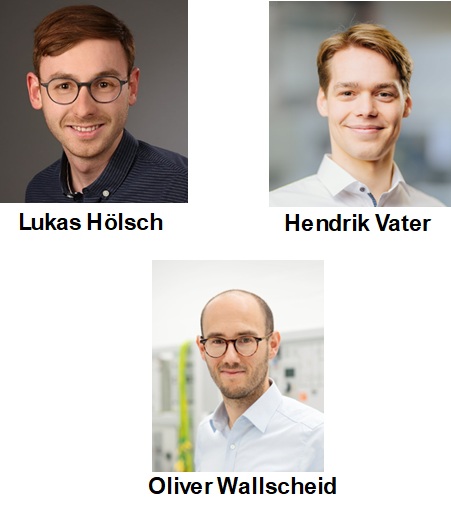
Lukas Hölsch received his B.Eng. and M.Eng. degrees in electrical engineering from HTWG Konstanz University of Applied Sciences, Germany, in 2020 and 2022 respectively. From 2022 to 2024 he worked as a Research Associate for the Department of Power Electronics and Electrical Drives, Paderborn University, Germany. Since then, he has worked as a Research Associate at the Chair of Interconnected Automation Systems (IAS), University of Siegen, Germany. His research interests include power electronics as well as control of electrical drives, in particular the calculation of optimized pulse patterns for highly utilized permanent magnet synchronous machines.
Hendrik Vater received the bachelor’s and master’s degree in electrical engineering from Paderborn University, Paderborn, Germany, in 2020 and 2023, respectively. He has been a research associate with the Department of Power Electronics and Electrical Drives, Paderborn University, from 2023 until 2025. Since 2026, he is a research associate with the Chair of Interconnected Automation Systems (IAS), University of Siegen, Germany. His research interests include system excitation, system identification, and intelligent control methods.
Oliver Wallscheid (Senior Member, IEEE) received the bachelor’s and master’s degrees (Hons.) in industrial engineering and the doctorate degree (Hons.) in electrical engineering from Paderborn University, Germany, in 2010, 2012,and 2017, respectively. He has been a senior research fellow with the Department of Power Electronics and Electrical Drives and acting professor of the Automatic Control Department, Paderborn University. Since 2024, he has been a full professor at University Siegen, Germany, and heading the Interconnected Automation Systems (IAS) Chair. His research interests include modeling, design, and control of electrical power systems focusing on decentralized grids, power electronics, and electrical drives.