

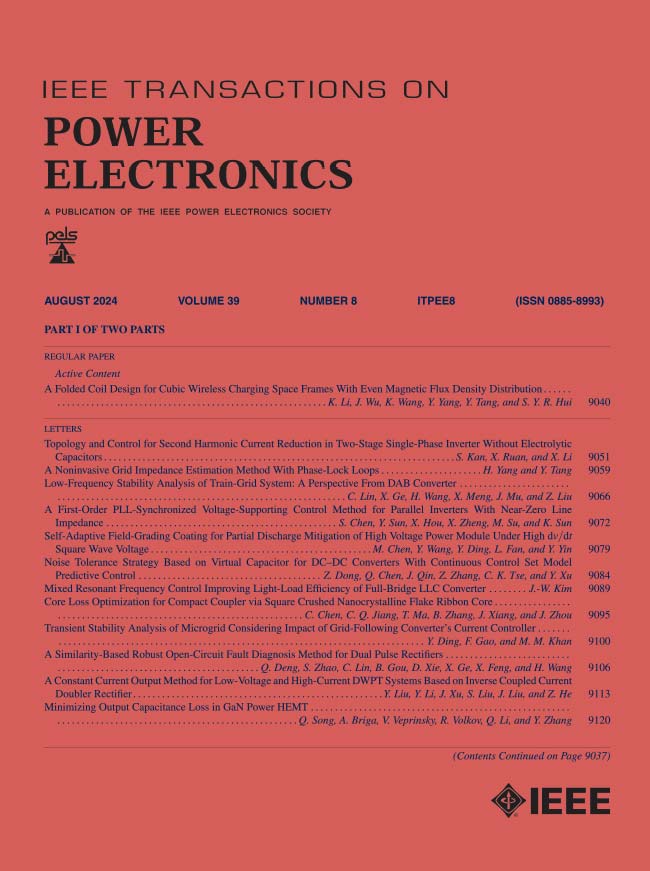
IEEE Transactions on Power Electronics
About the Publication
The IEEE Transactions on Power Electronics (TPEL) is a monthly publication where papers are available in Xplore shortly after acceptance.
The IEEE Transactions on Power Electronics (TPEL) covers all issues in the field of power electronics, including conversion, control, applications, conceptual issues, and system integration of electric power using semiconductors and switching devices. The focus of this journal encompasses power converters including components and system integration for their applications. This journal publishes works involving techniques and methodologies on modeling and simulation, analysis, design, fabrication, testing and characterization, evaluation and validation, and applications of power-electronic components, converters, converter systems, and system integrations. Review, tutorial, and survey articles with a viewpoint on the state-of-the-art and future technological advances are also welcome.
Papers that are not within the scope of the journal may/will be summarily rejected and the authors may be suggested to submit their work to a more suitable journal. Examples include but are not limited to manuscripts focused solely on physics, theory, materials, design and/or characterization of components, systems, and applications without sufficient and demonstrated content in power electronics.
For those who are researchers in the power electronics industry or aspiring to a university career, establishing a publications portfolio is essential. Getting published in the prestigious TPEL will help elevate a career to new heights!
TPEL Associate Editor Applications
Minimum requirements for AE Applicants
IEEE Senior Member or the equivalent number of years.
Applicants from Academia: 8 or more journal papers in the last 5 years, of which, at least 4 should be in IEEE Transactions on Power Electronics.
Applicants from Industry: 2 or more journal papers in the last 10 years, of which, at least 1 should be in IEEE Transactions on Power Electronics.
The Application Package (submit to to the TPEL Publications Adminstrator.)
1. A recent CV.
2. A list of published journal papers and patents in the last 10 years.
3. At least one recommendation letter.
5. A list of 10 reviewers to add to the reviewer pool of TPEL.
6. A completed AE topic questionnaire.
Latest Updates
Announcements
Open Calls for Papers
7.1
Impact Factor
0.07411
Eigenfactor
1.527
Article Influence Score
15.2
CiteScore
Publication Details
Further
Information
Information for Authors
Information on paper submission (e.g., correct formats, file types, etc.) can be found in TPEL’s submission guidelines. All submissions should be in a double-column format. The correct template can be found in the IEEE Template Selector. Authors should pay particular attention to documenting their work in relation to the known literature. For more information concerning tools and assistance with article preparation and submission, the proof review process, and ordering reprints, please visit the IEEE Author Center.
The articles in TPEL are peer-reviewed in accordance with the requirements set forth in the IEEE PSPB Operations Manual (sections 8.2.1.C & 8.2.2.A). Each published article was reviewed by a minimum of two independent reviewers using a single-blind peer-review process, where the identities of the reviewers are not known to the authors, but the reviewers know the identities of the authors. Articles will be screened for plagiarism before acceptance.
TPEL Policy on Experimental Results: Experimental results obtained from a full-hardware test setup are generally required for publication in IEEE Transactions on Power Electronics. In exceptional cases where even downscaled experimental validation cannot be provided, the authors must clearly justify why hardware-in-the-loop is sufficient for validating the claims made in the paper
TPEL Submission Guidelines: For the publication’s guidelines, click here.
TPEL’s Topic List: To see the list of topics for TPEL, please click here.
Active Content, Multimedia, and Graphic Abstracts: TPEL encourages authors to submit Active Content/Multimedia files (e.g., movies, simulation files, PowerPoints, etc.) with their papers if they believe the files will enhance the quality of the manuscript. All materials should be uploaded together at the time of submission. For more information, please read TPEL’s Active Content/Multimedia Instructions.
Institutional Emails: It is mandatory that all submissions have a primary email address that is institutional. Examples of institutional emails include those from an academic institution, a government agency, a company, or IEEE. Papers that do not meet this requirement will not be entered into the review process. To register for a free IEEE email account, please visit https://www.ieee.org/about/help/my-account/web-account.html.
Post-Conference Paper Submissions: Click here for more information on guidelines for post-conference papers.
Page Limits: An original TPEL Letter submission must be 4 pages in length.
An original TPEL regular paper submission has no page limit. PELS offers 10 pages at no charge. After 10 pages, there is an overlength page charge of $200 per page.
Submit a Paper
To submit a TPEL paper or Letter, click here: https://ieee.atyponrex.com/submission/dashboard?siteName=tpel-ieee
For questions regarding the author portal, please send an email to: authorportal@ieee.org. You also can visit the IEEE Author Center.
Editorial Board
Editor in Chief
- Xiongfei Wang (Tsinghua Univ., China)
Executive Editor (Letters)
- Maryam Saeedifard (Georgia Inst. of Tech., USA)
Editor at Large
- Yaow-Ming Chen (Natl. Taiwan Univ., Taiwan)
Co-Editors in Chief
Editors (Letters)
- Vivek Agarwal (Indian Inst. of Tech. - Bombay, India)
- Xiaonan Lu (Purdue Univ., USA)
- Yi Tang (Nanyang Tech. Univ., Singapore)
- Xinke Wu (Zhejiang Univ., China)
- J. Marcos Alonso (Univ. de Oviedo, Spain)
- Mahshid Amirabadi (Northeastern Univ., USA)
- Minjie Chen (Princeton Univ., USA)
- Luca Corradini (Univ. of Colorado, Boulder, USA)
- Ali Khajehoddin (Univ. of Alberta, Canada)
- Antonio Marques Cardoso (CISE Univ. of Beira Interior, Portugal)
- Brendan McGrath (RMIT Univ., Australia)
- Xinbo Ruan (Nanjing Univ. of Aeronautics and Astronautics, China)
- Dianguo Xu (Harbin Inst. of Tech., China)
Associate Editors
- Khaled Ahmed (Univ. of Strathclyde, Scotland)
- Francisco Azcondo (Univ. of Cantabria, Spain)
- Ebrahim Babaei (Univ. of Tabriz, Iran)
- Satish Naik Banavath (Indian Institute of Technology Dharwad, India)
- Juergen Biela (ETH Zurich, Switzerland)
- Honnyong Cha (Kyungpook Natl. Univ., Korea)
- Hicham Chaoui (Carleton Univ., Canada)
- Ching-Jan Chen (Natl. Taiwan Univ., Taiwan)
- Ke-Horng Chen (National Chiao Tung Univ., Taiwan)
- Ui-Min Choi (Seoul Natl. Univ. of Sci. and Tech., Korea)
- Francois Costa (Univ. Paris East Creteil, France)
- Han (Helen) Cui (Tianjin Univ., China)
- Shenghui Cui (Seoul Natl. Univ., Korea)
- Pooya Davari (Aalborg Univ., Denmark
- Ali Davoudi (Univ. of Texas - Arlington, USA)
- Giovanni De Carne (Karlsruhe Inst. Tech., Germany)
- Apparao Dekka (Lakehead Univ., USA)
- Jianning Dong (Delft Univ. of Tech., Netherlands)
- Jingyang Fang (Shandong Univ., China)
- Mehdi Ferdowsi (Missouri Univ. of Sci. and Tech., USA)
- Francisco Freijedo (Huawei Tech., Germany)
- Baoyun Ge (Georgia Inst. of Tech., USA)
- Saeed Golestan (Aalborg Univ., Denmark)
- Pedro Filipo da Costa Goncalves (Vestas Wind Systems A/S, Denmark)
- Lei Gu (Univ. of Pennsylvania, USA)
- Yunjie Gu (Imperial College London, UK)
- Yonghao Gui (Oak Ridge Natl. Lab., USA)
- Kosala Gunawardane (Univ. of Tech. - Sydney, Australia)
- Michael Hartmann (Schneider Electric, Austria)
- Jinwei He (Tianjin Univ., China)
- Marko Hinkkanen (Univ. of Aalto, Finland)
- Shu Yuen (Ron) Hui (Nanyang Tech. Univ., Singapore)
- Nik Rumzi Nik Idris (Univ. Tech. Malaysia, Malaysia)
- Junichi Itoh (Nagaoka Univ. of Tech., Japan)
- Herbert Ho-Ching Iu (Univ. Western Australia, Australia
- Bing Ji (Univ. of Leicester, UK)
- Shiqi Ji (Tsinghua Univ., China)
- Chaoqiang Jiang (City Univ. of Hong Kong, Hong Kong)
- Brian Johnson (Univ. of Texas - Austin, USA)
- Kishan Joshi (Intel Corp., USA)
- Jae-Jung Jung (Kyungpook Natl. Univ., Korea)
- Panagiotis Kakosimos (ABB, Sweden)
- Petros Karamanakos (Tampere Univ., Finland)
- Georgios Konstantinou (Univ. of New South Wales, Australia)
- Harish Krishnamoorthy (Univ. of Houston, USA)
- Alon Kuperman (Ben-Gurion Univ. of the Negev, Israel)
- Ching-Ming Lai (National Central Univ., Taiwan)
- Chi-Seng Lam (Univ. of Macau, China)
- John Lam (York Univ, Canada)
- Byoung Kuk Lee (Sungkyunkwan Univ., Korea)
- Chi Kwan Lee (Univ. of Tech. Sydney, Australia)
- Dong-Choon Lee (Yeungnam Univ., Korea)
- Eun S. Lee (Hanyang Univ., Korea)
- Kyo-Beum Lee (Ajou Univ., Korea)
- Sze Sing Lee (Newcastle Univ., Singapore)
- Binbin Li (Harbin Inst. of Tech., China)
- Helong Li (Hefei Univ. of Tech., China)
- Qiang Li (Virginia Tech, USA)
- Sinan Li (Univ. of Sydney, Australia)
- Yuan Li (Univ. of Pittsburgh, USA)
- Zixin Li (Chinese Academy of Sci., China)
- Tsorng-Juu (Peter) Liang (Natl. Cheng Kung Univ., Taiwan)
- Andreas Lindemann (Otto-von-Guericke-Univ. Magdeburg, Germany)
- Marco Liserre (Christian-Albrechts-Univ. zu Kiel, Germany)
- Jinjun Liu (Xi'an Jiaotong Univ., China)
- Dylan Dah-Chuan Lu (Univ. of Tech. Sydney, Australia)
- Oscar Lucia (Univ. of Zaragoza, Spain)
- Ke Ma (Shanghai Jiao Tong Univ., China)
- Ayan Mallik (Arizona State Univ., USA)v., China)
- Wilmar Martinez (KU Leuven, Belgium)China)
- Sudip Mazumder (Univ. of Illinois - Chicago, USA)
- Yasser Mohamed (Univ. of Alberta, Canada)
- Marta Molinas (Norwegian Univ. of Sci. and Tech., Norway)
- Mohammad Monfared (Swansea Univ., UK)
- Gerry Moschopoulos (Western Univ. Canada, Canada)
- Alireza Namadmalan (Bourns Inc., Ireland)
- Dorin Neacsu (Tech. Univ. of Iasi, Romania)
- Khai Ngo (Virginia Tech, USA)
- Demercil Oliveira (Federal Univ. of Ceará, Brazil)
- Martin Ordonez (Univ. of British Columbia, Canada)
- Ki-Bum Park (KAIST - Daejeon, Korea)
- Dimosthenis Peftitsis (Eindhoven Univ. of Tech., Netherlands)
- Xiaoze Pei (Univ. of Bath, UK)
- Han Peng (Huazhong Univ. of Sci. and Tech., China)
- Li Peng (Huazhong Univ. of Sci. and Tech., China)
- Mario Ponce-Silva (Natl. Center of Research and Tech. Dev., Mexico)
- Ting Qian (Virginia Tech, USA)
- Yaxiao Qin (Huawei Tech., Germany)
- Zian Qin (Delft Univ. of Tech., Netherlands)
- Dongyuan Qiu (South China Univ. of Tech., China)
- Xiaohui Qu (Southeast Univ., China)
- Tomi Roinila (Tampere Univ., Finland)
- Christian Rojas (Univ. Tech. Fed. Santa Maria - Valparaiso, Chile)
- Deepak Ronanki (India Inst. Of Tech. - Madras, India)
- Alireza Safaee (Apple Inc., USA)
- Subham Sahoo (Aalborg Univ., Denmark)
- Ariya Sangwongwanich (Aalborg Univ., Denmark)
- Jagabar Sathik Mohamed Ali (Prince Mohammed Bin Fahd University, Saudi Arabia)
- Giacomo Scelba (Univ. of Catania, Italy)
- Gab-Su Seo (Natl. Renewable Energ. Lab., USA)
- Qobad Shafiee (Univ. of Kurdistan, Iran)
- Bin Shao (Sillumin Semiconductor Inc., USA)
- Kuang Sheng (Zhejiang Univ., China)
- Tingna Shi (Zhejiang Univ., China)
- Bhim Singh (Indian Inst. of Tech. - Delhi, India)
- Yam Siwakoti (Univ. of Tech. - Sydney, Australia)
- Ziyou Song (Natl. Univ. of Singapore, Singapore)
- Mei Su (Central South Univ., China))
- Kai Sun (Tsinghua Univ., China)
- Nadia Tan Mei Lin (Univ. of Nottingham - Ningbo, UK)
- Shuilin Tian (Nanjing Univ. of Aero. and Astro., China)
- Andrzej Trzynadlowski (Univ. of Nevada, USA)
- Chi (Michael) Tse (Hong Kong Polytechnic Univ., China)
- Ioannis Tsoumas (ABB, Switzerland)
- Fred Wang (Univ. of Tennessee, USA)
- Laili Wang (Xi'an Jiaotong Univ., China)
- Mengqi Wang (Univ. of Michigan - Dearborn, USA)
- Yijie Wang (Harbin Inst. of Tech., China)
- Qiang Wei (Lakehead Univ., Canada)
- Jaime Wladimir Zapata Amores (Infineon Tech., Germany)
- Heng Wu (Southeast Univ., China)
- Hongfei Wu (Nanjing Univ. Aeronautics and Astronautics, China)
- Jinpeng Wu (Tsinghua Univ., China)
- Yan Xing (Nanjing Univ. of Aeronautics and Astronautics, China)
- Dehong (Mark) Xu (Zhejiang Univ., China)
- Wei Xu (Chinese Academy of Sci., China)
- Yingyi Yan (Analog Devices, USA)
- Tao Yang (Univ. of Nottingham, UK)
- Yongheng Yang (Zhejiang Univ., China)
- Yun Yang (Nanyang Tech. Univ., China)
- Jin Ye (Univ. of Georgia, USA)
- Cao Zhan (Tesla, USA)
- Di Zhang (GE Global Research, USA)
- Li Zhang (Leeds Univ., UK)
- Xinan Zhang (Univ. of Western Australia, Australia)
- Yi Zhang (Hong Kong Polytechnic Univ., China)
- Yongchang Zhang (North China Electric Power Univ., China)
- Yuhao Zhang (Univ. of Hong Kong, China)
- Zheyu Zhang (Clemson Univ., USA)
- Xiaoqiang Guo (Yanshan Univ., China)
- Dong Jiang (Huazhong Univ., China)
- Ahmed M. Sayed Ahmed (Rockwell Automation, USA)
- Sertac Bayhan (Hamad Bin Khalifa Univ., Qatar)
- Gaolin Wang (Harbin Inst. of Tech., China)
- Ruichi Wang (Loughborough Univ., UK)
- Ludovico Ortombina (Univ. of Padova, Italy)
- Suyong Chae (POSTECH, S. Korea)
- Jaeil Baek (KAIST, S. Korea)
- Tomokazu Mishima (Yamaguichi Univ., Japan)
Power Electronics Letters
The IEEE Transactions on Power Electronics covers all issues of widespread or generic interest to engineers who work in the field of power electronics. The Journal editors will enforce standards and a review policy equivalent to the IEEE Transactions, and only papers of high technical quality will be accepted. Papers which treat new and novel device, circuit or system issues which are of generic interest to power electronics engineers are published. Papers which are not within the scope of this Journal will be forwarded to the appropriate IEEE Journal or Transactions editors. Examples of papers which would be more appropriately published in other Journals or Transactions include:
- Papers describing semiconductor or electron device physics. These papers would be more appropriate for the IEEE Transactions on Electron Devices.
- Papers describing applications in specific areas: e.g., industry, instrumentation, utility power systems, aerospace, industrial electronics, etc. These papers would be more appropriate for the Transactions of the Society which is concerned with these applications.
- Papers describing magnetic materials and magnetic device physics. These papers would be more appropriate for the IEEE Transactions on Magnetics.
- Papers on machine theory. These papers would be more appropriate for the IEEE Transactions on Power Systems. While original papers of significant technical content will comprise the major portion of the Journal, tutorial papers and papers of historical value are also reviewed for publication.
Awards & Recognitions
Each year, the Editors and Associate Editors of TPEL recognize first place prize papers and second place prize papers deemed best among those published in TPEL during the preceding calendar year.
For information on this award, including eligibility, criteria, award items, and past recipients, please visit the Transactions on Power Electronics (TPEL) Prize Paper Award page.
Associate Editor Excellence
2025
Juergen Biela | Ui-Min Choi | Apparao Dekka | Demercil de Souza Oliveira | Francisco D. Freijedo | Michael Hartmann | Alon Kuperman | Chi-Seng Lam | Sze Sing Lee | Sinan Li | Mohammad Monfared | Dorin Neacsu | Khai Ngo |
Dimosthenis Peftitsis | Mario Ponce-Silva | Tomi Roinila | Deepak Ronanki | Shuilin Tian | Ioannis Tsoumas | Hongfei Wu
2024
Mahshid Amirabadi | Junichi Itoh | Herbert Ho-Ching Iu | Ali Khajehoddin | Harish Krishnamoorthy | John Lam | Oscar Lucia | Saad Mekhilef
2023
Jesus Acero | Francisco J. Azcondo | Ke-Horng Chen | Francois Costa | Saeed Golestan | Makoto Hagiwara | Ngai Man (Carl) Ho | Andreas Lindemann | Khai Ngo | Chi (Michael) Tse
Outstanding Reviewers
2025
Cai Chen | Pedro F. da Costa Gonçalves | Zhehui Guo | Jingxin Hu | Shan Jiang | Zhiheng Lin | Zekai Lyu | Chuan Sun | Oliver Wallscheid | Zhanqing Zhou
2024
Iman Abdoli | Ke-Horng Chen | Ruirui Chen | Appa Rao Dekka | Luigi Pio Di Noia | Kei Eguchi | Byeongcheol Han | Zhicong Huang | Chi-Seng Lam | Kerui Li | Yong Li | Run Min | Dimosthenis Peftitsis | Jorge A. Solsona | Yanjun Tian | Cheng Xue | Jingxi Yang | Yun Yang | Cao Zhan | Han Zhang
2023
Changsong Cai | Ke-Horng Chen | Yang Chen | Fujin Deng | Yongting Deng | Yueshi Guan | Sara Hasanpour | Jingxin Hu | Sze Sing Lee | Shouxiang Li | Yufei Li | Yicheng Liao | Xiaogang Lin | Hongchen Liu | Haoze Luo | Mohammad Monfared | Christian Alexis Rojas Monrroy | Sahra Saadatizadeh | Gaolin Wang | Shaojun Xie | Hua Zhang
Test of Time Papers
To celebrate 40 years of TPEL, the following papers have been selected as those that have stood the test of time:
“A General Approach to Sampled-Data Modeling for Power Electronic Circuits” by George C. Verghese, Malik E. Elbuluk, and John G. Kassakian (Volume PE-1, Issue 2, April 1986, pp. 76-89)
“A Comparison of Half-Bridge Resonant Converter Topologies” by Robert L. Steigerwald (Volume 3, Issue 2, April 1988, pp. 174-182)
“Direct Self-control (DSC) of Inverter-Fed Induction Machine” by Manfred Depenbrock (Volume 3, Issue 4, October 1988, pp. 420-429)
“Energy, Environment, and Advances in Power Electronics” by Bimal K. Bose (Volume 15, Issue 4, July 2000, pp. 688-701)
“Stationary Frame Current Regulation of PWM Inverters with Zero Steady-State Error” by Daniel Nahum Zmood and Donald Grahame Holmes (Volume 18, Issue 3, May 2003, pp. 814-822)
“Power Electronics as Efficient Interface in Dispersed Power Generation Systems” by Frede Blaabjerg, Zhe Chen, Søren Bækhøj Kjær (Volume 19, Issue 5, September 2004, pp. 1184-1194)
Contact Information
TPEL Editor in Chief Xiongfei Wang
TPEL Letters Executive Editor Maryam Saeedifard
TPEL Publications Administrator Mary Beth Schwartz
What’s Popular
Most Downloaded Articles
-
Analysis of Active Phase Jump Power Dynamics and Their Mapping to Grid-Forming Capability of VSCs
Source: Transactions on Power Electronics Published on: 2026-09-07
-
Metaheuristic-Based Optimization-Driven Design of MHz LLC Resonant Converters Considering Multiphysics and Multiple Objectives
Source: Transactions on Power Electronics Published on: 2026-08-10
-
Virtual EMF-based Current Limiting Control for Grid-Forming Inverters under Symmetrical and Asymmetrical Faults
Source: Transactions on Power Electronics Published on: 2026-08-04
-
Φ-SYNC: A Precurrent-Balancing Fast Phase-Adding Strategy for Multiphase VRMs in Data-Center Processors
Source: Transactions on Power Electronics Published on: 2026-06-29
-
Unified First-Order Power Synchronization Control of Grid-Forming Converters
Source: Transactions on Power Electronics Published on: 2026-06-02